IPC-2TCP-RPF series
The IPC-2TCP and IPC-2TCP-RPF are compact, dual uplink ReadyLinks clients with a RJ45 / Coax (F) combo ReadyLink port and two PoE+ Ethernet ports. Models, hardware configuration and default configuration.
ReadyLinks compact, dual uplink client, combining the simplicity of cloud-managed IT with the power of innovative ReadyLinks IP client technology. IPC-2TCP-RPF series clients are managed via the ReadyView dashboard and support the common IPC feature set.
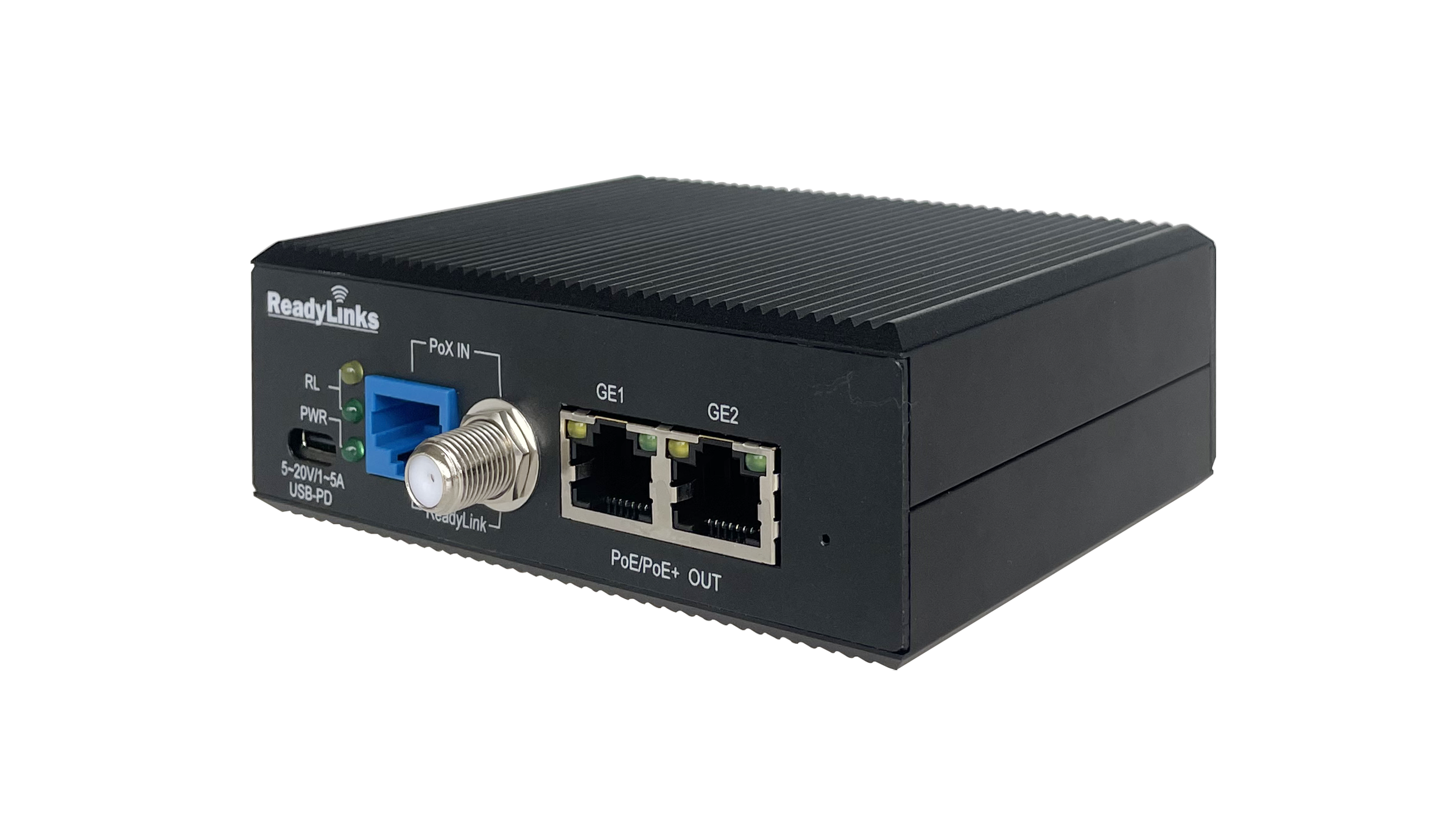
#Models
| IPC-2TCP | IPC-2TCP-RPF | |
|---|---|---|
| Cable medium | Twisted pair & Coax | Twisted pair & Coax |
| ReadyLink port | RJ45 / Coax (F) combo | RJ45 / Coax (F) combo |
| 1GbE RJ45 | 2 | 2 |
| PoE/PoE+ options | PoE+ | PoE+ |
| Mount type | Wall, desktop | Wall, desktop |
| Applications | Hospitality, Enterprise, ISPs | Hospitality, Enterprise, ISPs |
#Hardware configuration
The following hardware configuration is for the IPC-2TCP-RPF.
| IPC-2TCP-RPF | |
|---|---|
| Interfaces | 2 x 10M/100M/1G IEEE 802.3at PoE+ PSE (30W); 1 x 2G IEEE 802.3at PoE+ PD or PSE (30W) ITU-T G.hn F / RJ45 combo port; 1 x Secure 5/20V/1.5A USB-C PD |
| LEDs | RPF: reverse power feeding; RL: data link (ReadyLink) over coax or twisted pair; PWR: local power |
| Power | 1 x 2G ITU-T G.hn IEEE 802.3at PoE+ PD RJ45 or F connector; 1 x Secure 5/20V/1.5A USB-C PD |
| Power consumption | 3W |
| Dimensions | 4.2”(L) x 3.0”(W) x 1.4”(H) |
| Operating temperature | 14 ~ 131 °F |
| Cooling | Fanless heatsink |
#ReadyLink ports
- Fast Fourier Transform (FFT) Orthogonal Frequency-Division Multiplexing (OFDM) in 4-200MHz offers 2Gbps bit rate and PoE+ over 2-6 conductors.
- LDPC, FEC line condition adaptive
- ~40dB of attenuation in the frequency range 4-200MHz
#LEDs
The RPF, RL and PWR LED colors and their meanings are listed in the LED table on the Clients overview.
#Configuration
By default, the IPC-2TCP-RPF acts as a transparent bridge, simply passing traffic to and from the connected ReadyLink switchport. However, each IPC-2TCP-RPF is capable of advanced switching capabilities such as VLAN tagging, IGMP snooping, rate limits, etc.
For the recommended staging process before installation, see Deployment and staging in the IPC clients guide.